
The crowdsourcing business model is a collaborative approach in which organizations obtain ideas, services, content, funding, solutions, or contributions from a large group of people, typically through online platforms. Instead of relying solely on internal employees or traditional suppliers, businesses leverage the collective knowledge, skills, creativity, and resources of a broader community.
The rise of digital technologies, social media, online communities, and collaborative platforms has significantly expanded the use of crowdsourcing across industries. Businesses use crowdsourcing for product development, content creation, problem-solving, market research, software development, innovation challenges, and fundraising initiatives.
By accessing a diverse pool of contributors, organizations can gather insights and solutions from individuals with different experiences, expertise, and perspectives. As a result, crowdsourcing has become a widely adopted business model for innovation, engagement, and resource generation.
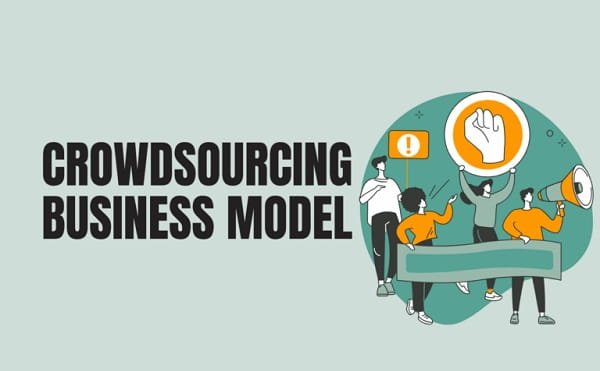
Crowdsourcing Business Model: Advantages vs Disadvantages
| Advantages | Disadvantages |
| Access to diverse ideas and expertise | Quality control challenges |
| Lower operational costs | Intellectual property concerns |
| Faster problem-solving | Difficulty managing contributors |
| Scalable participation | Inconsistent contribution quality |
| Increased innovation opportunities | Confidentiality risks |
| Community engagement | Dependence on participant interest |
| Flexible workforce access | Communication complexities |
| Broad talent pool | Potential legal issues |
| Market feedback opportunities | Project coordination challenges |
| Reduced development time | Unpredictable participation levels |
What is a Crowdsourcing Business Model?
A crowdsourcing business model involves obtaining contributions from a large group of individuals rather than relying solely on internal teams or traditional contractors.
Organizations may use crowdsourcing to gather:
- Ideas
- Creative content
- Technical solutions
- Product feedback
- Financial support
- Research data
- Specialized expertise
Participants can contribute voluntarily, competitively, or in exchange for compensation, recognition, rewards, or other incentives.
Key Characteristics of a Crowdsourcing Business Model
Community Participation
A large group of individuals contributes to projects or initiatives.
Open Collaboration
Organizations invite external participants to provide input or solutions.
Digital Platform Usage
Most crowdsourcing activities occur through online platforms.
Distributed Contributions
Participants may contribute from different geographic locations.
Collective Problem-Solving
The model utilizes group knowledge and expertise to address challenges.
How the Crowdsourcing Business Model Works
The crowdsourcing model follows a structured process.
1. Problem or Project Definition
The organization identifies a challenge, task, or objective.
Examples include:
- Product design
- Software development
- Market research
- Content creation
2. Community Engagement
The project is presented to a target audience or contributor network.
3. Contribution Collection
Participants submit ideas, solutions, content, or feedback.
4. Evaluation and Selection
The organization reviews and assesses contributions.
5. Implementation
Selected contributions are incorporated into the final project or solution.
Types of Crowdsourcing Business Models
Idea Crowdsourcing
Organizations gather suggestions and innovative concepts from contributors.
Content Crowdsourcing
Users create articles, videos, images, reviews, or other content.
Crowdfunding
A large group of individuals contributes financial resources to support projects.
Microtask Crowdsourcing
Participants complete small tasks that contribute to larger objectives.
Innovation Crowdsourcing
Organizations seek solutions to technical or business challenges.
Open Source Crowdsourcing
Communities collaborate on software development and technology projects.
Advantages of the Crowdsourcing Business Model
1. Access to Diverse Ideas and Expertise
Crowdsourcing enables organizations to gather perspectives from individuals with different backgrounds and skill sets.
This diversity may support:
- Innovation
- Creativity
- Problem-solving
2. Lower Operational Costs
Organizations may reduce expenses associated with:
- Hiring full-time staff
- Specialized consulting
- Internal research teams
3. Faster Problem-Solving
Large contributor groups can work on challenges simultaneously.
This may accelerate:
- Idea generation
- Product development
- Research activities
4. Scalable Participation
Businesses can expand contributor involvement according to project requirements.
5. Increased Innovation Opportunities
External contributors may introduce ideas that differ from internal approaches.
6. Community Engagement
Crowdsourcing encourages interaction between organizations and participants.
This may strengthen:
- Brand awareness
- Customer involvement
- Community loyalty
7. Flexible Workforce Access
Organizations can access contributors without establishing long-term employment relationships.
8. Broad Talent Pool
Crowdsourcing platforms may attract participants with specialized knowledge across numerous fields.
9. Market Feedback Opportunities
Businesses can gather customer opinions during product development processes.
10. Reduced Development Time
Parallel contributions from multiple participants may shorten project timelines.
Disadvantages of the Crowdsourcing Business Model
1. Quality Control Challenges
Contributions often vary significantly in quality.
Organizations may need processes for:
- Screening submissions
- Evaluating accuracy
- Reviewing content
2. Intellectual Property Concerns
Questions may arise regarding ownership of submitted ideas and solutions.
3. Contributor Management Complexity
Large contributor networks may require:
- Communication systems
- Moderation tools
- Participation guidelines
4. Inconsistent Contribution Quality
Not all submissions meet project requirements or standards.
5. Confidentiality Risks
Sharing project details with external participants may expose sensitive information.
6. Dependence on Participant Interest
Crowdsourcing initiatives often rely on active community engagement.
Low participation may affect outcomes.
7. Communication Challenges
Managing interactions with large groups can become complex.
8. Legal and Compliance Issues
Organizations may encounter concerns related to:
- Copyright
- Licensing
- Data protection
- Contributor agreements
9. Project Coordination Difficulties
Coordinating multiple contributors may require significant planning and oversight.
10. Unpredictable Participation Levels
The volume and quality of contributions can vary across projects.
Revenue Sources in a Crowdsourcing Business Model
Organizations using crowdsourcing platforms may generate revenue through multiple channels.
Platform Fees
Charges for access to crowdsourcing services.
Project Commissions
Revenue earned from facilitating projects between organizations and contributors.
Subscription Plans
Recurring fees for premium platform features.
Advertising Revenue
Income from promotional placements on crowdsourcing platforms.
Transaction Fees
Charges applied to completed contributions or project transactions.
Crowdsourcing vs Traditional Business Model
| Feature | Crowdsourcing Model | Traditional Business Model |
| Workforce Source | External contributors | Internal employees |
| Idea Generation | Community-driven | Organization-driven |
| Talent Pool | Broad and distributed | Limited to workforce |
| Project Participation | Open to contributors | Restricted to employees |
| Cost Structure | Often variable | Generally fixed |
| Innovation Source | External and internal | Primarily internal |
| Scalability | Highly scalable | Workforce-dependent |
| Collaboration Method | Distributed participation | Centralized management |
| Resource Access | Community-based | Organization-owned |
| Feedback Collection | Direct from contributors | Internal processes |
Industries Commonly Using Crowdsourcing Models
Technology
- Software development
- Open-source projects
- Innovation programs
Media and Content
- User-generated content
- Content creation platforms
- Review platforms
Consumer Products
- Product design
- Customer feedback initiatives
- Market testing programs
Research and Development
- Scientific collaboration
- Innovation challenges
- Problem-solving competitions
Finance
- Crowdfunding platforms
- Investment communities
- Financial innovation projects
Key Metrics Used in Crowdsourcing Businesses
Contributor Participation Rate
Measures the percentage of users actively contributing.
Submission Volume
Tracks the number of ideas, solutions, or contributions received.
Project Completion Rate
Measures the percentage of projects successfully completed.
Community Growth Rate
Tracks increases in contributor participation over time.
Contribution Quality Score
Evaluates the usefulness and effectiveness of submissions.
FAQs
Q: What is a crowdsourcing business model?
A: A crowdsourcing business model obtains ideas, content, solutions, services, or resources from a large group of external contributors.
Q: How does crowdsourcing differ from traditional business operations?
A: Crowdsourcing relies on external participants and community contributions, whereas traditional models primarily depend on internal employees and resources.
Q: What are the major advantages of crowdsourcing?
A: Commonly discussed advantages include access to diverse expertise, lower costs, faster problem-solving, innovation opportunities, and community engagement.
Q: What are the major disadvantages of crowdsourcing?
A: Frequently cited disadvantages include quality control issues, intellectual property concerns, participation uncertainty, confidentiality risks, and coordination challenges.
Q: What is crowdfunding?
A: Crowdfunding is a form of crowdsourcing in which individuals contribute funds to support projects, businesses, or initiatives.
Q: What is idea crowdsourcing?
A: Idea crowdsourcing involves collecting suggestions, innovations, and creative concepts from a broad group of participants.
Q: Which industries commonly use crowdsourcing?
A: Technology, media, consumer products, research, education, finance, and software development industries frequently use crowdsourcing approaches.
Q: Why is quality control important in crowdsourcing?
A: Contributions may vary in quality, accuracy, and relevance, making evaluation processes essential.
Q: How do crowdsourcing platforms generate revenue?
A: Revenue may come from platform fees, subscriptions, project commissions, advertising, and transaction charges.
Q: What metrics are commonly used to evaluate crowdsourcing initiatives?
A: Common metrics include participation rate, submission volume, project completion rate, community growth, and contribution quality scores.









Leave a Reply